I spend most of my time supporting executives making the jump to founder. It’s the transition I know best, and the one almost everyone underestimates.
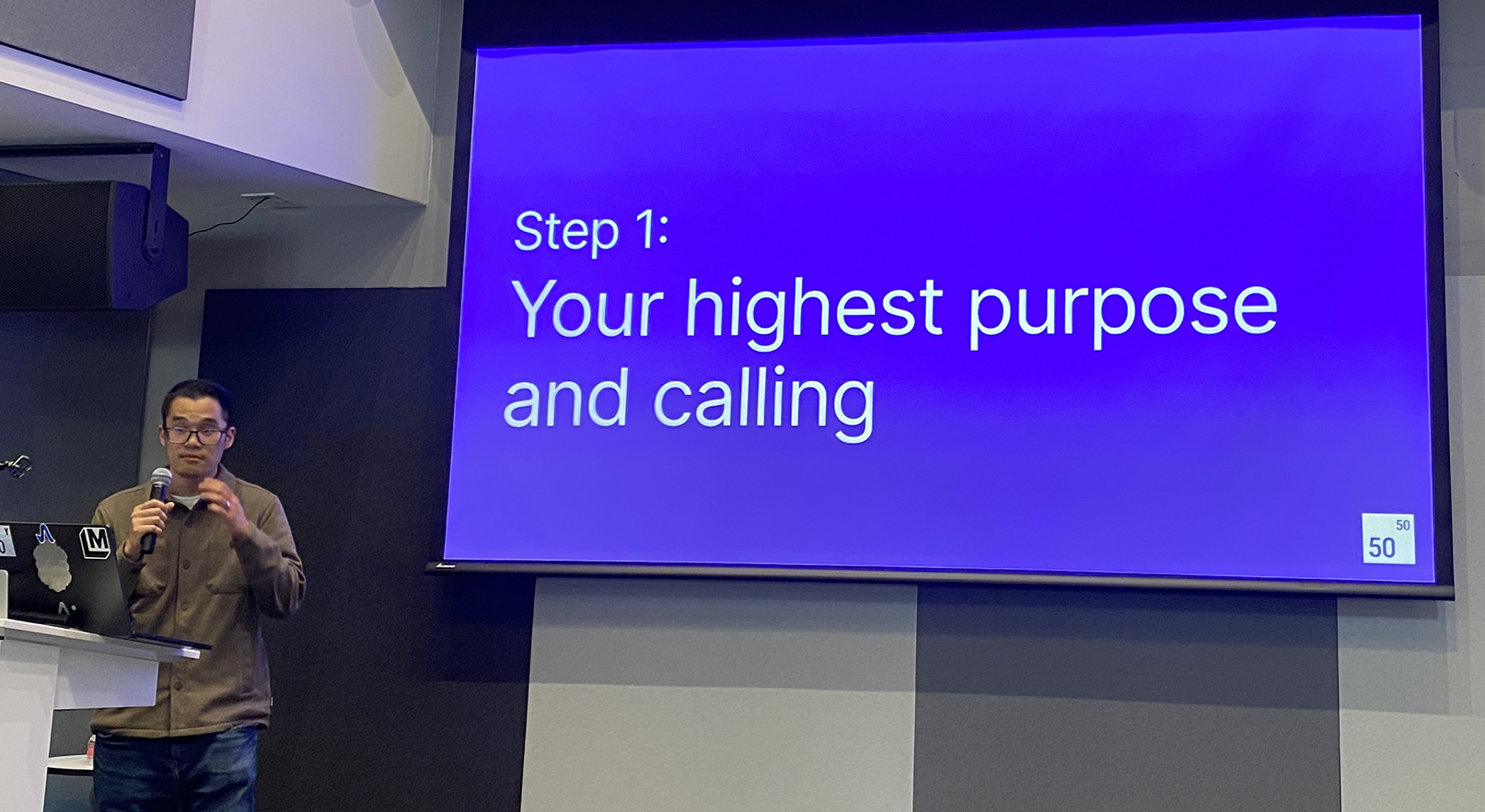
The best talk I’ve seen this year on that leap came from a VC — and the two lines that stuck with me were the last things you’d expect one to say: know your highest calling, and don’t do it for the money. By highest calling he meant the plain stuff we rush past: what actually matters to you, what you’re world-class at, what you’d be doing if money weren’t a constraint.
Businesses that are purely a financial play are a hard slog and rarely throw off the big wins — the builders with planetary impact, from Lister (antiseptic surgery) and Fleming (penicillin) to Haber (synthetic fertilizer) and Shockley (the transistor), weren’t chasing a payday. The value came because they were doing the thing they couldn’t not do. Most VCs never talk this way. They’re asking why they should care about you, not telling you to know thyself.
On a recent trip back to the Bay Area, I took the long BART ride across the bay to hear Alex Teng of Fifty Years — a deep-tech seed fund backed by 46 founders of billion-dollar-plus companies — speak at UC Berkeley’s Bakar Labs. I’d had Fifty Years on my radar for a while: I once helped a founder get acquired in the scientific logistics space, and Austin VC Akhil Aneel spoke highly of them.
Over 90 minutes he wove the hard mechanics of venture together with the personal questions underneath them. Three of his ideas map almost perfectly onto where I watch executives get tripped up: that the founder’s real job is turning the obviously impossible into the maybe-possible, that you have to ground the mission in real human well-being, not the raise, and that there’s no single “way to be” as a leader.
The impossible-to-maybe-possible job
This is the first instinct executives have to unlearn. As an executive, you solve stable, team-driven problems with resources behind you. The first years of founding are more like surviving a shipwreck and navigating the open sea in a small raft. The job isn’t executing a plan — it’s building a feedback loop with constant failure and winning back 1% of the battle at a time. Many exec-to-founders overweight their successes inside a company as a read on how they’ll fare alone in the open water.
Mission over the raise
Here’s where “don’t do it for the money” gets interesting. Many of the execs I work with never take venture dollars at all — they put $200–500K of their own, plus friends and family, behind a mission to change an industry. Some of the most serious founders I see are self-funded. (Ironically, that’s often where VCs come looking — I now have investors who source from my events.)
And this is where it connects: winning 1% a day on the raft is how you build a system that compounds value to customers over 10 or 20 years. That’s the Buffett and Munger worldview, and the current running through the Founders Podcast. Whether you’re operationally funded or venture-backed, the payoff comes from compounding, not the raise.
Build your own way to lead
Executives are trained to adopt the playbook. Founders have to build their own. Growth comes from getting clear on your goals and values, then putting enough in motion to get honest feedback on whether your choices move you toward them. It’s iteration on your own path, not adoption of someone else’s.
He closed on something I’ve believed since moving to Austin and getting deep into founder biographies: don’t just read business books — read biographies. Frameworks tell you what worked; biographies show you what it cost, and how someone held their nerve when the plan broke. That’s the thing you can’t get secondhand. If I had to choose between my MBA and six months of building while listening to the Founders Podcast, it wouldn’t be close.
If you don’t know your highest calling, the raft won’t be fun — and it’s hard to succeed at something you’re not, in some deep way, enjoying (fun isn’t the same as easy). Mine took me a while to name: I feel it when I help people find the right raft. If you’re an executive feeling the pull toward founding, the leap is real and the raft is smaller than you think. But it’s the most alive I’ve seen people become.
John Davison
Founder & CTO, StartupLandia